
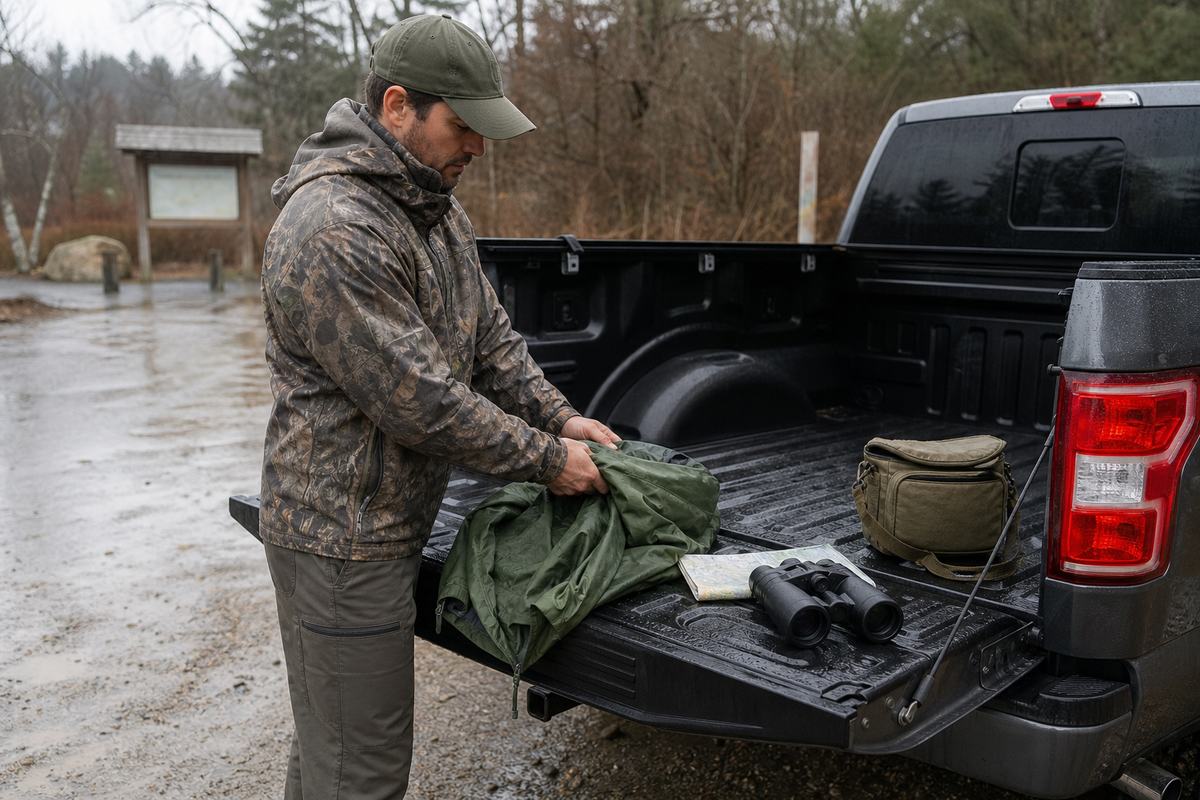
You have one free Saturday, legal permission to hunt a familiar parcel and a forecast that has shifted from light rain to strong afternoon wind. The practical question is not simply what to carry, but whether your planned route, clothing, optics and timing still fit the conditions. Reading the ground before leaving helps you make a quieter, safer and more ethical choice instead of forcing a marginal outing because time is limited.
Start with the permission, season and access plan
Before studying wind direction or packing equipment, confirm that the hunt is allowed where and when you intend to conduct it. Check current rules for the species, season dates, licensing, legal methods, tagging, land access and any hunter-identification or visibility requirements in your jurisdiction. Regulations can change, so general advice cannot replace current information from the relevant wildlife agency, land manager or other official source.
The parcel may also have less obvious restrictions. A public area could include a closure, temporary access condition, protected habitat zone or boundary that is easy to cross accidentally. Private land requires current permission, not an assumption based on an earlier visit. Save maps offline, mark property lines and choose parking that will not block a gate, disturb residents or damage soft ground.
This check can change the entire setup. If legal access leaves only a narrow entry route, a heavy load and bulky clothing may become liabilities. If the ground is saturated, a shorter walk from a responsible parking point may be better conservation than driving farther across a vulnerable track.
Let weather change the route, not just the clothing
A forecast is useful only when translated into decisions. Rain affects traction, visibility, scent movement and trail conditions. Wind can make a familiar stand uncomfortable, noisy and difficult to monitor safely. A sudden temperature change may turn a comfortable morning into an overheated walk followed by a cold wait.
For this outing, check the forecast close to departure and again before moving to a second location. Note wind direction and expected shifts, precipitation timing, temperature range and daylight conditions. Then ask: Can I travel without excessive noise? Can I remain warm and dry without constant adjustment? Can I leave safely if the weather worsens?
Choose layers rather than one heavy garment. A quiet outer layer, moisture-managing clothing and a packable waterproof shell provide more control than dressing for the coldest part of the day from the start. Keep wet-weather gear accessible, but do not let a crowded pack make movement loud. Match footwear to the actual surface: firm soles and ankle support may suit uneven ground, while aggressive tread helps only if it does not encourage travel across fragile or restricted terrain.
Match equipment to the ground you can responsibly cover
Good gear does not compensate for poor terrain judgment. Study a map for elevation changes, drainage, thick cover, fences, water crossings and likely exit routes. Satellite images can help, but they may be outdated; compare them with recent local knowledge and visible conditions where appropriate.
If the parcel has a steep approach and a wet basin below, a compact pack, reliable navigation, quiet rain protection and enough food and water may be more useful than specialized equipment for a longer sit you may never reach. Carry a charged phone, backup navigation method, basic first-aid supplies and a light source, while protecting critical items from moisture.
Check optics and other field equipment before the trip, not for the first time in poor weather. Inspect straps, fasteners, batteries and lens protection. Secure loose items that can rattle. If a piece of equipment requires repeated attention, ask whether it belongs in this setup or merely reflects an idealized version of the hunt.
Build an ethical decision point into the day
Ethical hunting includes recognizing when conditions have crossed a line. Poor visibility, unstable footing, extreme fatigue, uncertain target identification or a shot opportunity without a responsible outcome are reasons to pause or leave. No planned route or hoped-for result justifies avoidable risks or a rushed decision.
The same principle applies to disturbance. Avoid pushing through sensitive cover simply because it appears productive on a map. Respect other hunters, hikers, livestock, homes and seasonal habitat restrictions. Keep noise and travel within what the land can absorb, and leave gates, vegetation and access points as you found them or better.
A useful pre-departure checklist is short:
– Confirm current regulations, permission and boundaries.
– Check weather, daylight and the safest exit route.
– Match clothing and footwear to wet, cold, steep or noisy ground.
– Test navigation, communication, optics and essential safety items.
– Set a clear limit for visibility, fatigue and changing conditions.
Decide that limit before leaving: what will make you turn around, wait or end the hunt? A preset threshold is easier to follow than a judgment made after hours of effort.
Treat habitat as part of the hunting plan
Conservation is part of preparation. Your route, parking choice, treatment of wet ground and handling of waste affect habitat and future access. Stay on durable surfaces when possible, avoid trampling regeneration or nesting areas identified by land managers, and use established crossings rather than creating shortcuts.
After the outing, record conditions that may help with future planning, such as a washed-out trail, damaged gate, unusual erosion or closure sign missing from an older map. Report genuine hazards through the appropriate land manager or agency channel rather than relying on informal posts that may become outdated.
The Saturday decision may be a shorter hunt, a later start or no hunt at all. That is not a failed plan. It means you read conditions honestly, matched equipment to reality and protected the land, wildlife and public trust that make responsible hunting possible.